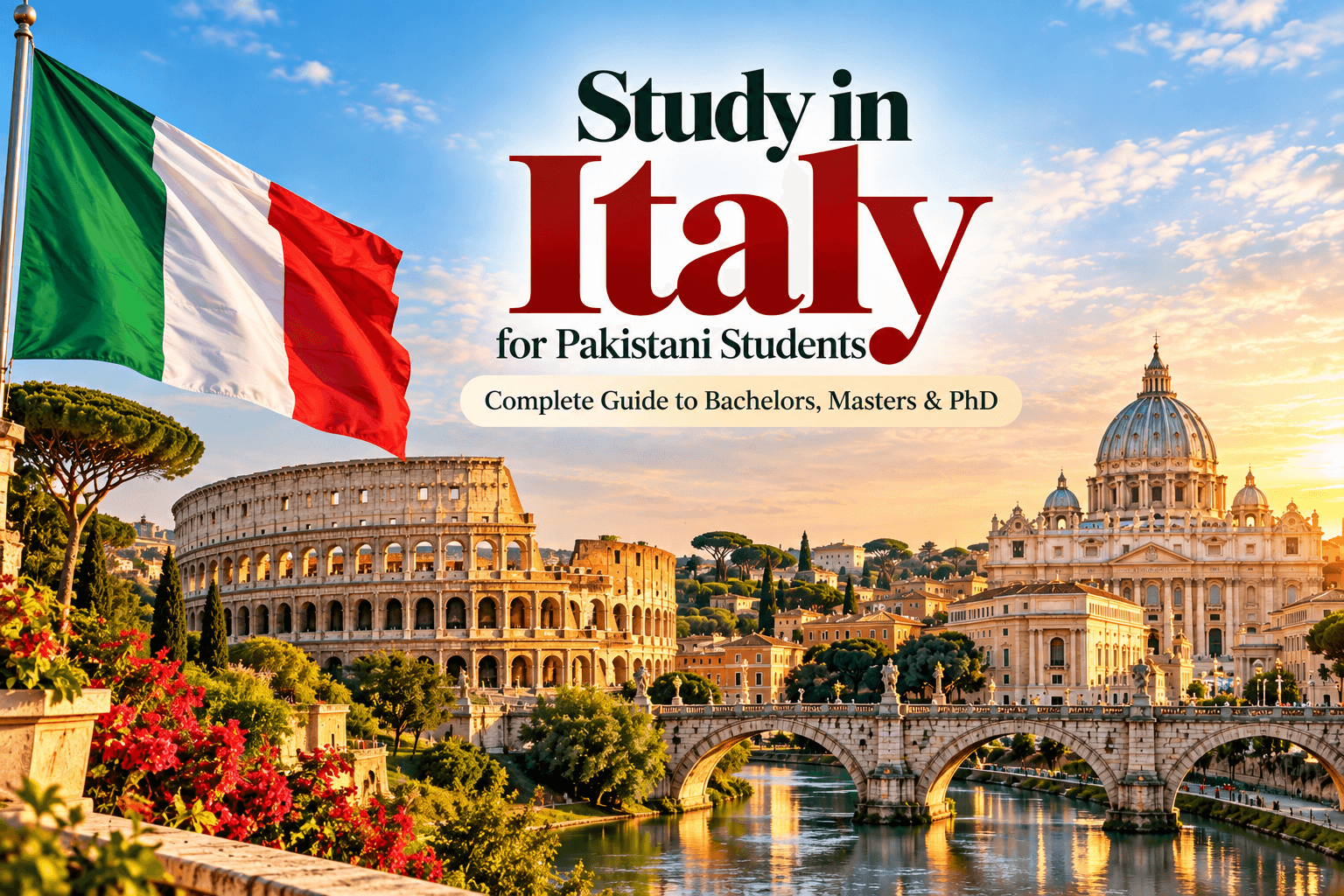
Study in Italy for Pakistani Students:
Complete Guide for Bachelors, Masters & PhD
Italy has become a destination for students who want quality higher education in Europe. Italian universities offer programmers and many of them are taught in English. Public universities can be scholarships, university fee reductions and government-funded opportunities can lower the overall cost of education.
For students Italy offers study opportunities at three levels: Bachelors, Masters and PhD. Each level has its admission requirements, documentation, scholarship opportunities and visa procedures.
Why Study in Italy?
Italy offers advantages for students, including:
Affordable tuition at many public universities
Numerous English-taught programmer’s
Regional scholarships for international students
Government scholarships such as MAECI
Funded PhD opportunities
globally recognized universities
Opportunities for part-time work
Access to European academic and professional opportunities.
Some of the well-known universities in Italy include the University of Bologna University of Padua Sapienza University of Rome University of Milan, University of Pisa, University of Turin Politecnico di Milano and Politecnico di Torino.
Bachelors Admission in Italy
Students applying for a Bachelors programmer usually need a completed Intermediate/HSSC qualification or an equivalent 12 years of education.
Common Requirements
Matric/SSC certificate and transcript
Intermediate/HSSC certificate and transcript
valid passport
Language certificate, where required
Programmed-specific entrance test, where
Motivation letter or CV where required
other documents requested by the university
Students applying for programmers such as medicine, architecture or certain engineering programmers may need to pass an entrance examination.For programmers universities may require IELTS, TOEFL or another accepted proof of proficiency. Requirements vary depending on the university and programmer.
Masters Admission in Italy
Students applying for a Master’s degree normally need a Bachelor’s degree.
Typical Documents
Bachelor’s degree
transcript
Passport
CV
Motivation letter or Statement of Purpose
Recommendation letters if required
English or Italian language certificate
Course syllabus if requested
CIMEA or Declaration of Value documents where required
The Bachelor’s degree should be academically compatible with the selected Masters programmer. Universities may also have credit or subject requirements.
PhD Admission in Italy
PhD admission is different from Bachelors and Masters Admission. Applicants generally need a Master’s degree along with an academic and research profile.
Typical Requirements
Masters. Transcript
Bachelor’s degree and transcript
CV
Research proposal
References
Publications or research experience, where applicable
Language proficiency
Interview
Many Italian PhD positions are connected to scholarships or funded research projects. Applicants should therefore look specifically for PhD positions. Carefully review the funding conditions of each programmer.
Tuition Fees in Italy
Tuition fees vary significantly between universities and programmers. There is no tuition fee to all Italian universities.
At public universities tuition can range from €500 to €4,000 or more per year depending on the university, programmer and student’s financial situation.
For students this can be PKR 1.6 lakh to PKR 13 lakh or more per year depending on the exchange rate and the actual university fee.
Some universities also provide tuition fees or complete fee exemptions through scholarships and financial-aid programmer.
Scholarships for Pakistani Students
Scholarships are one of the advantages of studying in Italy. International students can explore scholarships, university scholarships and Italian government-funded opportunities.
Regional Scholarships
Italian regions offer need-based scholarships to students.
Depending on the region and annual scholarship call benefits can include:
Tuition-fee exemption or reduction
University accommodation
subsidized meals
Cash scholarship
Additional student benefits
Examples include ER.GO in Emilia-Romagna, EDISU Piemonte and LazioDiSCo.
Applicants normally need to provide family documentation from Pakistan to establish their situation.
MAECI Scholarship
The Italian Ministry of Foreign Affairs and International Cooperation offers scholarships to students for selected Masters, PhD and other programmer.
For the 2026/27 year the published total scholarship amount is €10,800 to the conditions and payment schedule specified in the official call.
Pakistani applicants should check the MAECI announcement because eligible countries, programmes, requirements and deadlines can change from one year to another.
Invest Your Talent in Italy
Invest Your Talent in Italy is another opportunity for selected students applying to Masters and postgraduate programmer.
The programmer can provide support along with an internship opportunity with a company or organization.
English Language Requirements
one of the questions among Pakistani students is whether IELTS is compulsory for studying in Italy.
The answer is not always.
Some universities and programmer accept alternatives to IELTS while others specifically require IELTS, TOEFL or another recognized English-language qualification.
Therefore Italy should not simply be described as a “No IELTS” study destination. Language requirements depend on the university and programmer.
Documents Required from Pakistan
Students should prepare their documents well before beginning the admission and visa process.
Common documents include:
Passport
CNIC
Matric certificate and transcript
Intermediate certificate and transcript
Bachelor’s degree and transcript for Masters applicants
Master’s degree and transcript for PhD applicants
CV
Motivation letter
Recommendation letters, where required
Language certificate
CIMEA or Declaration of Value, where required
Financial documents
Accommodation documents
Health insurance
University admission letter
University pre-enrolment documentation
Educational documents may also require apostille/legalization and Italian translation depending on the university and visa requirements.
Italian Student Visa
Pakistani students generally apply for a National D Study Visa for long-term study.
The overall process usually follows this sequence:
University Admission → Universitaly Pre-enrolment → University Validation → Visa Application → Visa Decision → Travel to Italy
The university must validate the student’s Universitaly pre-enrolment before the visa application process can proceed.
Students should prepare their visa documentation carefully. Ensure that all financial and academic information is genuine and consistent.
Financial Requirements
Applicants must demonstrate resources for their stay in Italy.
Depending on the circumstances visa applicants may need to provide:
Bank statements
Sponsor information
Income evidence
Tax documentation
Family Registration Certificate
Proof of relationship with the sponsor
supporting financial documents
For applicants financial history should be genuine, consistent and properly documented. Large unexplained deposits shortly before the visa application can create concerns during the assessment.
Cost of Living in Italy
Living expenses vary depending on the city and lifestyle.
A reasonable planning range for a student is €600–€1,000+ per month
Accommodation is generally the largest monthly expense.
Smaller cities can be more affordable than Milan, Rome and other major cities. Shared accommodation can also significantly reduce costs.
Part-Time Work
International students can work time in Italy subject to immigration and employment regulations.
However part-time employment should be considered income than the primary source of funding for education and living expenses.
Students still need to demonstrate capacity for their visa application.
Residence Permit
After arriving in Italy international students staying for a period need to apply for a Permesso di Soggiorno or residence permit.
The process should be completed according to the instructions provided by the university and Italian authorities. Students should keep copies of all submitted documents and appointment receipts.
Estimated First-Year Budget
A Pakistani student can consider the following first-year budget:
Expense Approximate Range
Tuition €500–€4,000+
Living expenses €7,200–€12,000+
Visa Around €50
Residence permit and related costs €100+
Insurance Variable
Flight Variable
Documentation Variable
A reasonable overall planning budget can therefore be around €9,000–€16,000+ for the year depending on tuition fees, accommodation, city and lifestyle.
With a university scholarship the out-of-pocket cost can be significantly lower.
Application Process for Pakistani Students
The application process can be divided into the following steps:
Select the degree and field.
Search for universities and programmer.
Check language requirements.
Check university and scholarship deadlines.
Prepare documents.
Submit the university application.
Receive the admission decision.
Complete qualification verification, if required.
Complete Universitaly pre-enrolment.
Wait for university validation.
Prepare the student visa application.
Submit the visa application.
Travel to Italy after visa approval.
Complete residence-permit and university enrolment procedures after arrival.
Best Fields to Study in Italy
Italy offers programmes across a range of disciplines. Popular options for students include:
Computer Science
Artificial Intelligence
Data Science
Cybersecurity
Mechanical Engineering
Electrical Engineering
Civil Engineering
Architecture
Business Administration
Economics
Finance
International Relations
Renewable Energy
Biotechnology
Environmental Sciences
The suitable programmer depends on the student’s previous qualification, academic record, career goals and available programmer.
Common Mistakes to Avoid
students should be careful to avoid the mistakes:
Assuming every Italian university has extremely low tuition
Assuming IELTS is never required
Applying without checking programmer-specific requirements
Ignoring scholarship deadlines
Submitting incomplete financial documentation
Using fake or unexplained financial documents
Choosing an unrelated Masters programmer
Missing the Universitaly pre-enrolment process
Relying completely on part-time work
Paying unofficial agents for visa appointments
Ignoring document translation and apostille requirements
Life in Italy as an International Student
Studying in Italy is not about academics. International students also experience a culture, education system and lifestyle.
Students can participate in university clubs, academic events, internships and student organizations. Learning Italian can also make activities such, as shopping, transportation, accommodation and communication easier.
Italys cities offer a mix of buildings, cultural events, international groups and student life. Students should plan money carefully. Keep a balance between school work and social time.
Career Opportunities
Students can explore internships part-time jobs and professional networking while studying.
Universities often give career services, job fairs, workshops and links with employers. Building experience during university can be useful when applying for jobs after graduation.
Students should also research options. Understand immigration rules that apply after finishing a degree.
Italy can be a study destination for students because it mixes internationally recognized universities with relatively low tuition and many scholarship opportunities.
For Bachelors students the main priorities are finding a programmer that works and meeting academic, entrance-test and language requirements.
For Masters Students Italy offers chances through scholarships, university fee cuts MAECI and programmes such as Invest Your Talent, in Italy.
For PhD applicants finding a research project and ideally a funded PhD position is very important.
The important step is to check university, Universitaly and Italian Embassy requirements before making financial commitments. Admission rules, tuition fees, scholarship rules and visa procedures can change from year, to year.