
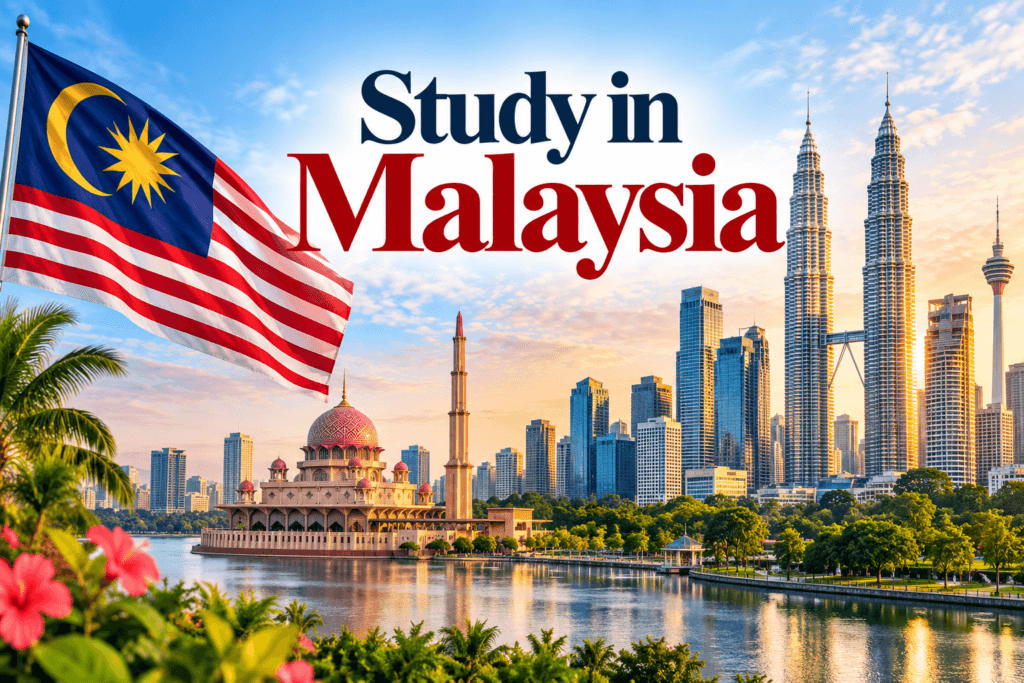
Study in Malaysia: Courses, Fees & Visa Guide
Malaysia is a place for students who want to find a good education in Asia. Malaysia offers diploma, bachelor, master and PhD programs and most courses are taught in English. I think Malaysia is much cheaper than the UK, Australia and Canada. Malaysia still lets students go to recognized universities and foreign branch campuses.
Why Choose Malaysia for Higher Education?
One of the things about Malaysia is that tuition fees and living costs are quite low. Students can choose to study at universities, private institutions or international branch campuses. Universities offer programs in fields such as business, computer science, engineering, information technology, medicine, biotechnology, hospitality, finance, education and social sciences. Malaysia is also very close to Pakistan which makes traveling between the two countries easy. The many different cultures in Malaysia and the use of English in school can make life easier for students.
Study Programs Available
Pakistani students can apply for levels of education based on what they have already studied. Diploma programs usually take two to three years. You can find diploma programs in areas like business, information technology, engineering, hospitality, tourism and design. Bachelor degrees usually take three to four years. Popular programs include Computer Science, Software Engineering, Artificial Intelligence, Cyber Security, Business Administration, Accounting and Finance Engineering, Psychology, Biotechnology and Hospitality Management.
Students who already have a bachelor degree can apply for master programs. These master programs can be based on coursework or research. Usually take one to two years. PhD programs are also available in areas such as business, engineering, computer science, education, biotechnology, economics, public health and social sciences. People applying for a PhD normally need a master degree and a research proposal.
Admission Requirements for Pakistani Students
The admission requirements depend on the university and the program. For bachelor admission students normally need 12 years of education like Intermediate/HSSC, A-Levels or something similar.Students applying for master programs usually need a bachelor degree and PhD applicants normally need a master degree.Other papers you will need include a passport, academic certificates, transcripts, photographs, proof of skills and documents from the university.I should note that there is no percentage or CGPA rule for every Malaysia University. Some popular programs or universities might ask for better grades.
English Language Requirements
I have heard people say that IELTS is never needed for Malaysia. That is not always true. The English requirements depend on the university and the program.Some schools might let you use proof that you studied in English. Other schools will ask for IELTS, TOEFL, PTE or another test.Because of this students without IELTS should not assume that every Malaysia University will say they do not need it. You should always check the university and the program before you apply.
Tuition Fees
Tuition fees change depending on the school. What you study. Public universities are usually cheaper. Private universities and international branch campuses can cost more.
If you are planning your budget a bachelor degree might cost between RM30,000 to RM100,000 or even more. Some programs are more expensive than that. Master programs may cost RM20,000… Etc. Students should also keep in mind that Malaysia started a 6% sales and service tax on tuition fees for students in July 2025 old price lists might be wrong.
Living Expenses in Malaysia
Malaysia is usually more affordable than places to study. The cost of your house, food, travel and personal things depends on the city.
How you live.
A student can often plan to spend around RM1,200 to RM2,000 per month. Your house and lifestyle might make this cost more.Students living in Kuala Lumpur or big cities might spend money than students in smaller cities.
Bank Statement Requirement
Some people say Malaysia has ‘no bank statement requirement.’ I think you should be careful with that idea.Some people say Malaysia has ‘no bank statement requirement.’ You should be careful with that idea.
There is no set bank balance rule for every student like in some countries.. Universities, sponsors or certain cases might still ask to see your money. Students should still keep proof that they have money even if the school does not ask for a bank statement when applying.
Malaysian Student Visa
International students usually follow the Student Pass process through Education Malaysia Global Services (EMGS) and Malaysian Immigration. The process starts after you get an offer letter from a school. Then the student sends in the papers for the Student Pass. Once it is approved you finish the visa steps before you travel to Malaysia. When you arrive the student must finish the tests and the Student Pass endorsement.
Pakistani students should follow all the rules carefully because visa rules and papers can change.
Documents required for the Student Pass
Students should normally prepare:
A passport that is still valid is very important because the Student Pass process needs a passport.
Medical Examination
International students must do a health check after they arrive in Malaysia. New students should do this after arriving so the Student Pass can be finished.Students should go to a clinic that is approved by EMGS.
Part-Time Work
International students can work part-time in Malaysia. The rules are strict.Students can usually work up to 20 hours per week during holidays or breaks if immigration says it is okay.This means Malaysia is not a place where students can work all the time during the semester. Students should have money to live without needing a part-time job.
Scholarships
Scholarships come from universities or government programs. Depending on the scholarship students might get fees, full tuition, money for living or research money.I think scholarship chances are very good for postgraduate and research students.. Remember, scholarships are hard to get and rules change.Students should know if they are getting a tuition discount or a real funded scholarship before they make plans.
Universities, in Malaysia
Malaysia has established universities. Some well-known ones are University of Malaya University Putra Malaysia, University Kebangsaan Malaysia, University Sains Malaysia, University Teknologi Malaysia, International Islamic University Malaysia, Taylors University, Sunway University UCSI…
Students can choose between universities, private institutions and international branch campuses.
“Universities offer programs in fields such as business, computer science, engineering, information technology, medicine, biotechnology, hospitality, finance, education and social sciences.”
“Malaysia is also geographically close to Pakistan making travel between the two countries easier.”
“The multicultural environment and the wide use of English in education can make the move easier for students.”
“Study Programs Available”
“Pakistani students can apply for levels of education depending on their qualifications.”
“Diploma programs generally last two to three years. Diploma programs are available in areas such as business, information technology, engineering, hospitality, tourism and design.”
“Bachelor degrees last three to four years. Popular programs include Computer Science, Software Engineering, Artificial Intelligence, Cyber Security, Business Administration, Accounting and Finance Engineering, Psychology, Biotechnology and Hospitality Management.”
“Students who already hold a bachelor degree can apply for master programs. These may be coursework-based or research-based and commonly last one to two years.”
“Ph.D. Programs are also available in areas such as business, engineering, computer science, education, biotechnology, economics, public health and social sciences. Research applicants normally require a master degree and a research proposal.”
“Admission Requirements for Pakistani Students”
“Admission requirements depend on the university and program. For bachelor admission students normally need 12 years of education such as Intermediate/HSSC, A-Levels or an equivalent qualification.”
“Students applying for master programs generally need a bachelor degree while Ph.D. Applicants normally require a master degree.”
“Other required documents include a passport, academic certificates and transcripts photographs English-language evidence where required and university-specific documents.”
“There is no percentage or CGPA requirement that applies to every Malaysia university. Competitive programs and universities may require profiles.”
“IELTS and English Language Requirements”
“One common misconception is that IELTS is never required for Malaysia. In reality English requirements depend on the university and program.”
“Some institutions may accept education conducted in English or another approved form of English-language evidence while others may require IELTS, TOEFL, PTE or another accepted test.”
“Therefore students without IELTS should not assume that every Malaysia university will waive the requirement. The specific university and program should always be checked before applying.”
“Tuition Fees”
“Tuition fees vary according to the institution and field of study. Public universities are generally more affordable while private universities and international branch campuses can cost more.”
“As a planning estimate bachelor tuition can range from RM30,000 to RM100,000 or more for the degree although some programs can be more expensive.”
“Master programs may cost RM20,000 to RM60,000 or more while Ph.D. Costs vary according to the university, research area and duration.”
“Students should also remember that Malaysia introduced a 6% sales and service tax on tuition fees for students from July 2025; older fee quotations may not reflect the cost.”
“Living Expenses in Malaysia”
“Malaysia is generally considered affordable than Western study destinations. Accommodation, food, transportation and personal expenses depend on the city and lifestyle of the student.”
“A student can often plan around RM1,200 to RM2,000 per month for living expenses although accommodation and lifestyle can push this amount higher.”
“Students living in Kuala Lumpur and other major urban areas may have expenses than students studying in smaller cities.”
“Bank Statement Requirement”
“Malaysia is sometimes promoted as a country with ‘no bank statement requirement.’ This statement should be used carefully.”
“Malaysia is sometimes promoted as a country with ‘no bank statement requirement.’ This statement should be used carefully.”
“There is no fixed bank-balance requirement published for every student in the way that some countries prescribe an amount for maintenance funds. However universities, sponsors or individual cases may still request evidence.”
“Students should therefore maintain proof of capacity when a particular institution does not specifically request a bank statement during admission.”
“Malaysian Student Visa”
“Malaysian Student Visa”
“International students normally follow the Student Pass process through Education Malaysia Global Services (EMGS) and Malaysian Immigration.”
“The general process begins after receiving an offer letter from an institution. The student then submits the required documents, for the Student Pass application. After approval the relevant visa approval and pre-arrival procedures are completed before the student travels to Malaysia.”
“After arrival the student must complete the examination and Student Pass endorsement procedures.”
Malaysia also has branch campuses. These give students a chance to get degrees from universities in places like the United Kingdom and Australia without having to travel
Intake Periods
Many private universities in Malaysia have intakes through the year.
Common intake periods include January or February May or June and September or October.
Not every program is open during every intake. Students should check the university course before they make an application plan.
Post-Study Opportunities
The Malaysia Graduate Pass lets some international graduates stay in Malaysia for a while after they finish their education programs. Whether a student can get this depends on their nationality and other rules. Pakistani students should not think Pakistani students automatically qualify for the Graduate Pass. You should check the eligibility list before you decide to use work or stay opportunities as a reason to choose Malaysia.
Advantages for Pakistani Students
Affordable compared with destinationsEnglish-medium programs are widely availablediploma, bachelors, masters and PhD programsMultiple university choicesInternational branch campusesAffordable living costsGeographical proximity to PakistanMultiple intakes at institutionsScholarship and tuition-discount opportunitiesStructured Student Pass system
Considerations
Students should also learn about the limits. IELTS is not always waived at every university. Part-time work is restricted. Tuition fees change a lot. Post-study options depend on nationality and the current immigration rules.Students should also avoid making decisions based on claims like “no IELTS ” “no bank statement,” or “guaranteed visa.” Every application should be looked at based on the student profile, the chosen institution, money and the current Malaysian immigration requirements.
Malaysia is a place to study for students who want an education at a cost. Malaysia offers programs, cheap living options, well-known universities and international branch campuses.
For students Malaysia is very attractive when the main goal is to get a qualification without the costs of places like the UK, Australia or Canada. Students should carefully check admission rules, requirements, tuition fees, visa papers, work limits and post-study eligibility before applying. A well-planned application based on the student profile and money can make Malaysia a strong choice for education in 2026. Malaysia is a place for students who want an education that is known over the world in Asia. Malaysia offers diploma, bachelor, master and PhD programs and most courses are taught in English. Compared with the UK, Australia and Canada Malaysia is cheaper overall. Malaysia still gives access to well-known universities and foreign branch campuses.
Why Choose Malaysia for Higher Education?
One of the advantages of Malaysia is the mix of tuition fees and low living costs.Students can choose between universities, private schools and international branch campuses.Universities offer programs in areas like business, computer science, engineering, information technology, medicine, biotechnology, hospitality, finance, education and social sciences.
Malaysia is also close to Pakistan, which makes travel between the two countries easy. The multicultural environment and the wide use of English in education can make the move easier for students.
Study Programs Available
Pakistani students can apply for levels of education depending on what qualifications Pakistani students have. Diploma programs usually take two or three years. These are available in areas like business, information technology, engineering, hospitality, tourism and design. Bachelor degrees usually take three or four years. Popular programs include Computer Science, Software Engineering, Artificial Intelligence, Cyber Security, Business Administration, Accounting and Finance Engineering, Psychology, Biotechnology and Hospitality Management. Students who already have a bachelor degree can apply for master programs. These can be. Usually take one or two years. PhD programs are also available in areas like business, engineering, computer science, education, biotechnology, economics, public health and social sciences. Research applicants usually need a master degree and a research proposal.
Admission Requirements for Pakistani Students
Admission requirements depend on the university and the program. For bachelor admission students normally need 12 years of education such as Intermediate/HSSC, A-Levels or an equivalent qualification. Students applying for master programs normally need a bachelor degree while PhD applicants normally need a master degree. Other documents you need include a passport, academic certificates, transcripts, photographs, English-language proof if needed and documents specific to the university.
There is no percentage or CGPA requirement, for every university.
Competitive programs and universities may need profiles.